 Husky Dog Sledding Tromsø
Best Time for Dog Sledding in Tromsø: A Month-by-Month Guide
February and March are the best time for dog sledding in Tromsø. The snow season normally runs from November to April, but by February the trails are well established, the deep cold of midwinter has eased and the days are back to seven hours of light and climbing. March adds almost twelve hours of daylight and an average high just above freezing, which is the classic husky window. The runner-up is November into December, when the season opens under polar night and blue midday twilight. The window to treat with care is late April on the coast, when thaw can shorten rides or push them onto wheeled wagons. Before the snow arrives, some kennels run wheeled carts, and summer brings puppy training instead of sledding. This guide walks through every month with real climate figures, then helps you pick from the current husky dog sledding in Tromsø options. Prices and sled times sit side by side in husky dog sledding in Tromsø.
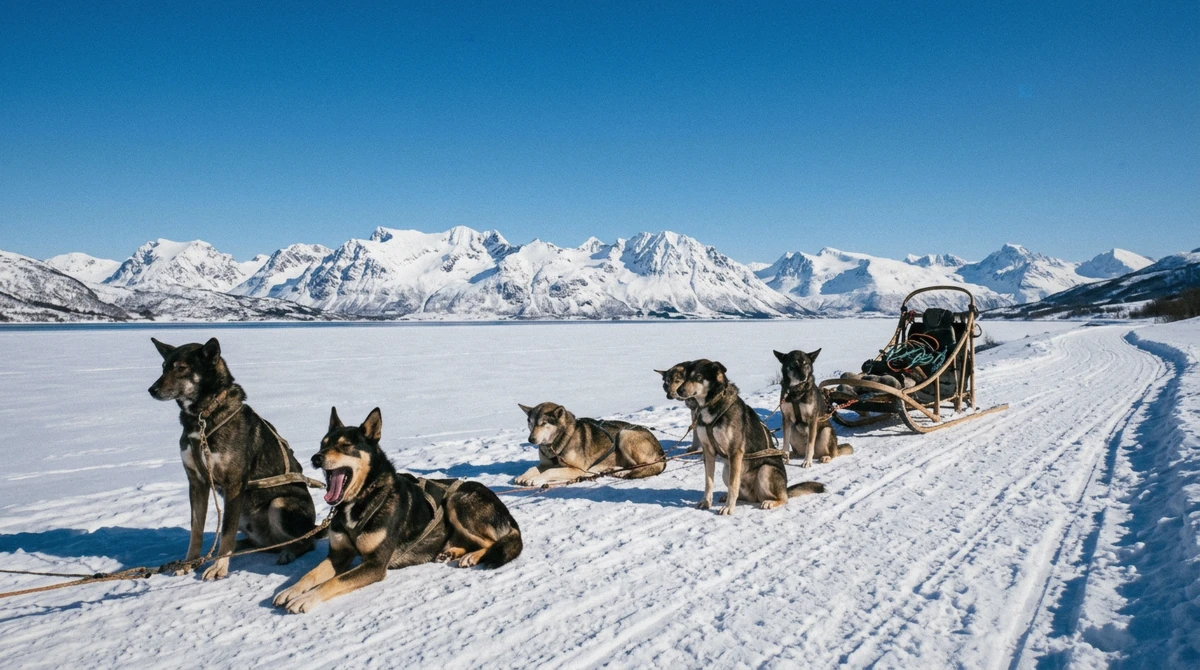
Illustrative image of a sunny March break on the trail.
Quick answer February and March best, November and December good, April risky, October wheeled
Snow-based dog sledding in Tromsø usually runs from November to April, depending on snow conditions. February and March are the strongest months, with cold snow, stable trails and real daylight: average highs around -1°C (30°F) in February and 0.6°C (33°F) in March. November and December work well if you accept short days and, in the polar night from about 26 November to 15 January, a few hours of blue twilight around midday. April has the longest days but a rising thaw risk on the coast. October normally has too little snow for sleds, though some kennels run wheeled carts, and summer offers puppy training rather than a ride.
Key takeaways
- February and March are the sweet spot: cold snow plus 7 to almost 12 hours of daylight.
- November and December open the season in blue twilight, as on this short self-drive husky ride.
- Late April carries thaw risk on the coast, so inland trips like the Tamokdalen dog sledding day trip hold up better.
- Inland valleys such as Tamok are usually colder than the city, which helps their snow hold.
- Polar night sledding is not dark all day: midday is blue twilight, and evening options like the northern lights husky visit fill the dark hours.
Best Time by Traveler Type
If You want the classic daylight photo trip
Book February or March, when trails are settled and sunshine climbs from 36 to 111 hours a month, for example a self-drive day on Kvaløya.
If You also want the northern lights
Go from November to January, sled in the blue midday hours and watch for aurora in the dark evenings, but accept that no tour promises lights.
If You are traveling with young children
Aim for February or March for the most reliable snow, and pick an option like the guided husky ride with lunch, which takes all ages.
If You are chasing the lowest price
Look at October and early November, when some kennels run cheaper wheeled-cart sessions, or summer's puppy training visit, the cheapest listing in the catalog.
If Your dates are fixed in late April
Choose an inland kennel, since valleys such as Tamok usually keep deeper, colder snow than the coast.
The Snow Season at a Glance
Dog sledding on snow in Tromsø is usually available from November to April, according to Visit Tromsø, and always depends on snow conditions. Outside that window some kennels run wheeled carts when it is cold enough for the dogs, and summer is for puppy training. The table below reads month by month.
The daylight column uses met.no normals and the polar night dates published for Tromsø. The verdict column compresses each month into a few words so you can scan fast.
Read the verdicts as a summary of the sections below, not a promise. A mild November can open late and a snowy April can run beautifully to the end.
| Month | Snow and trail conditions | Typical weather | Daylight | Verdict |
|---|---|---|---|---|
| January | Settled snow, coldest trails | High around -1°C (30°F), low about -5°C (23°F) | About 1.8 hours, mostly twilight | Deep cold, very dark |
| February | Best trails of the season | High about -1°C (30°F), low about -6°C (21°F) | About 7.4 hours | Best overall |
| March | Cold snow, long days | High about 1°C (33°F), low about -4°C (24°F) | About 11.8 hours | Best overall |
| April | Good early, thaw risk late | High about 4°C (39°F), low about -2°C (28°F) | About 16.3 hours | Good but softening |
| May | Season ends, snow mostly gone at the coast | High about 9°C (48°F) | Midnight sun from about 18 May | Sledding over |
| June | No snow, summer training | High about 13°C (55°F) | Very long days | Puppy season |
| July | No snow, summer training | High about 16°C (61°F) | Midnight sun | Puppy season |
| August | No snow, summer training | High about 15°C (59°F) | Days shortening | Puppy season |
| September | Autumn rains begin | High about 11°C (52°F) | Shortening fast | Sled season nears |
| October | First dustings, usually too thin | High about 5°C (41°F), low about 1°C (34°F) | About 8.9 hours | Wheeled carts at best |
| November | Season opens when snow arrives | High about 2°C (36°F), low about -2°C (28°F) | About 3.6 hours, polar night from about 26 November | Good early season |
| December | Full winter, deep dark | High about 0°C (33°F), low about -4°C (25°F) | Falling to zero at solstice | Good, twilight only |
Two adjacent months need one honest note: March and early April are genuinely close in trail quality, and the difference is warmth, not snow depth. The gap that matters most is October versus November, when the season flips from wheels to runners.
Temperatures, Rain and Daylight by Month
The figures below are met.no climate normals for 1991-2020 for Tromsø. Temperatures are Celsius first with Fahrenheit in brackets, daylight is average hours per day where published, and wet days counts days with at least 1 mm of precipitation. What you can book reflects the current catalog.
Hedge in mind: these are long-term averages, so check the current forecast close to your dates.
| Month | Avg high | Avg low | Daylight hours | What you can book |
|---|---|---|---|---|
| January | -1°C (30°F) | -5°C (23°F) | 1.8 | Snow sled tours, twilight departures |
| February | -1°C (30°F) | -6°C (21°F) | 7.4 | Snow sled tours, evening husky visit |
| March | 1°C (33°F) | -4°C (24°F) | 11.8 | Snow sled tours, evening husky visit |
| April | 4°C (39°F) | -2°C (28°F) | 16.3 | Snow sled tours early, thaw risk late |
| May | 9°C (48°F) | 2°C (36°F) | Midnight sun from about 18 May | Season gap |
| June | 13°C (55°F) | 6°C (43°F) | Very long days | Puppy training |
| July | 16°C (61°F) | 9°C (48°F) | Midnight sun | Puppy training |
| August | 15°C (59°F) | 8°C (47°F) | Long days | Puppy training |
| September | 11°C (52°F) | 5°C (41°F) | Shortening | Season gap |
| October | 5°C (41°F) | 1°C (34°F) | 8.9 | Wheeled carts at some kennels |
| November | 2°C (36°F) | -2°C (28°F) | 3.6 | Snow sled tours when open, aurora evenings |
| December | 0°C (33°F) | -4°C (25°F) | Near zero at solstice | Snow sled tours, aurora evenings |
The numbers tell the whole story. December is the darkest and close to the coldest month. February and March pair deep-freeze nights with sharply growing sunshine, from 36 hours in February to 111 hours in March.
April is the wet-warm pivot, with an average high of 4.1°C (39°F) that starts melting coastal trails.
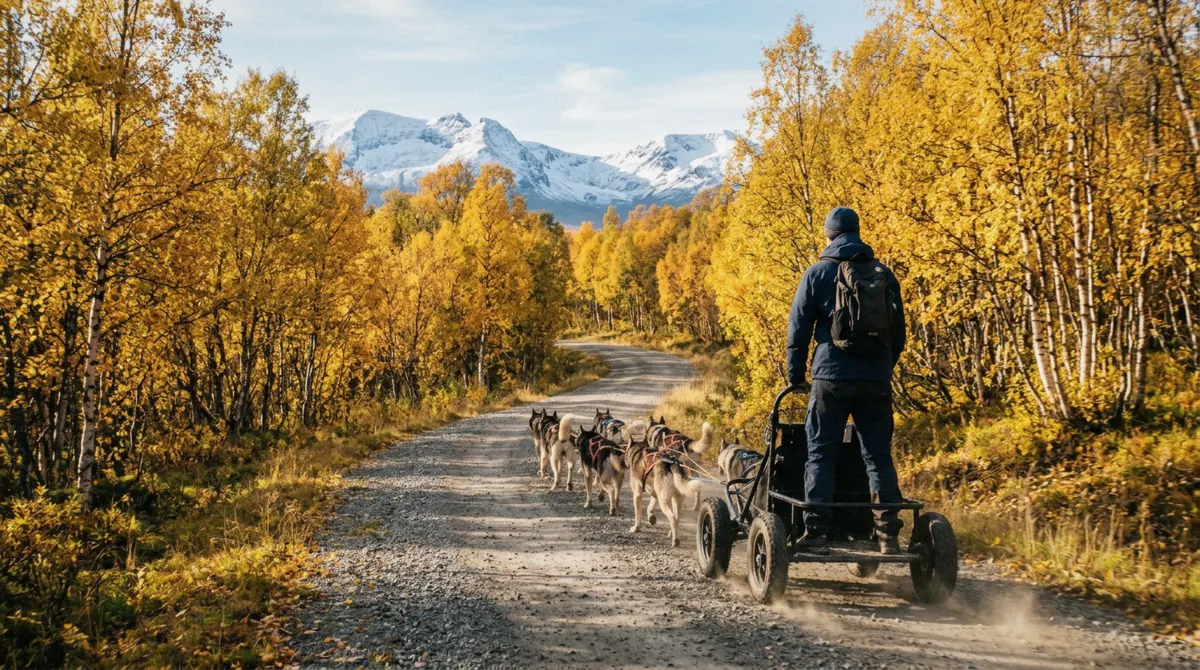
Illustrative image of autumn training on a wheeled cart.
February and March: The Sweet Spot
These two months combine the things every other month trades away. The cold has eased from the -5°C (23°F) average lows of midwinter to around -4°C (24°F) in March, which your toes will notice. And the light returns fast: February offers about 7.4 hours of daylight, March about 11.8, so you see the mountains, the dogs and the trail instead of headlights.
Why the trails ride better
Colder snow means firmer trails and less friction under the sled runners. Around Tromsø the coastal kennels on Kvaløya and at Breivikeidet get their season into full swing, and the inland valley of Tamok holds its powder. This is also the window where every tour type runs at full capacity, from the fun and easy Breivikeidet sledding day to private kennel visits.
The trade-offs
Popularity is the main one. February and March are when most visitors come, so popular departures can fill and booking a few weeks ahead is wise. Prices do not drop either, since this is peak demand.
If your dates are flexible within the window, late March gives you the most light.
The Polar Night and Blue Twilight
From about 26 November to 15 January the sun stays below the horizon in Tromsø, and the mountains hide it from about 21 November to 21 January. That sounds like sledding in the dark, and it is not. Days still have a few hours of blue twilight around midday, a soft light that photographers often prefer to flat noon sun.
Daytime sled tours in this window are built around that midday glow.
Sledding here means the landscape shows itself in shades of blue and pink, with headlamps for the kennel work and the dogs' breath hanging in the cold. January is the extreme: about 1.8 hours of usable light per day on average. Many travellers pair a daytime sled with an evening at the dog yard, since the northern lights husky visit with dinner runs in the dark hours and no compared tour guarantees aurora.
In the polar night, pick a late-morning departure to catch the blue hours.
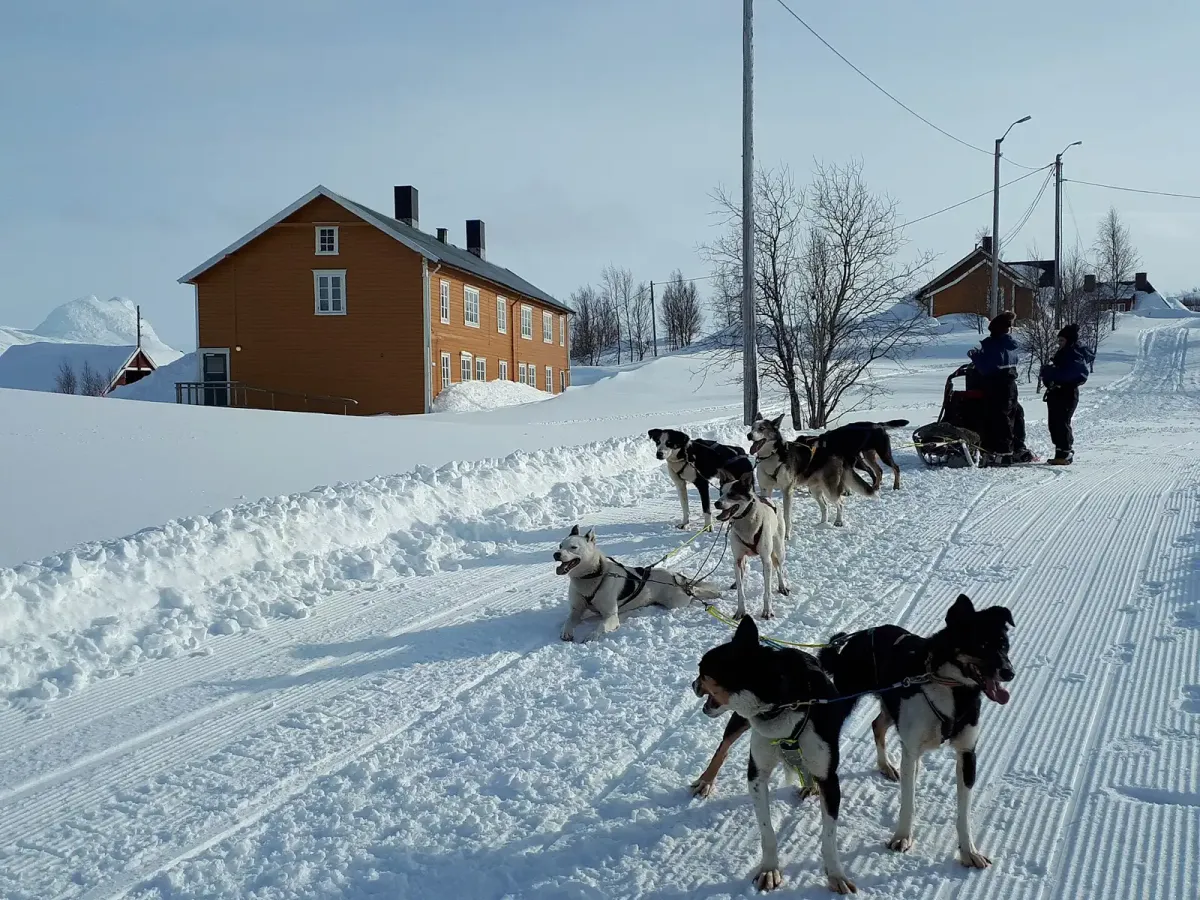
Sled dogs on an inland trail in northern Norway. Illustrative, photographed at Jakobsbakken. Photo: Jakobsbakken, CC BY-SA 4.0, via Wikimedia Commons.
Can You Go Dog Sledding in October and November?
Here is the direct answer. October in Tromsø averages a high of 5.2°C (41°F) and has the wettest month of the year by rain days, with 17.7 days at 1 mm or more. Snow at sledding depth is unusual.
If you book husky time in October, expect a wheeled cart or wagon session at the kennel rather than a sled on snow, which some kennels run when it is cold enough for the dogs. It is real dog work, just not a sled on a snowy trail.
November is different. The average high is 2.1°C (36°F) and falling, and Visit Tromsø puts the usual snow-sledding season start in this month. Early November can still be thin on the coast, and some listings state plainly that when snow is short the ride moves to wheeled wagons.
From mid to late November, with the polar night arriving around the 26th, the season is normally properly running. Book a departure with free cancellation, which every listing compared offers up to 24 hours before the start, and keep your first-choice date plus a spare morning.
October versus November in one line
October is a wheeled-cart month with a slim chance of early snow, while November usually brings snow sledding back, depending on conditions. If snow sledding is the whole point of your trip, aim for late November or later.
April and the Thaw Risk
April starts as one of the best months and ends as one of the trickiest. The daylight is glorious, about 16.3 hours a day, and early April can bring a good mix of snow and sun. But the average high climbs to 4.1°C (39°F), and on the coast around Tromsø that means wet, slow snow by late in the month.
Kennels respond by shortening loops, starting earlier in the day or, in thin years, moving rides onto wheeled wagons.
The fix is geography. Inland valleys such as Tamok are usually colder than the city and hold deeper, colder snow, which is exactly why the Tamokdalen dog sledding day trip runs its camp there. The trip costs three hours on the bus in total, so it is a full-day commitment, but late in the season that is the trade worth making.
The private family kennel in Målselv, about two hours from Tromsø by car, sits inland too and adapts its route and running time to conditions on the day.
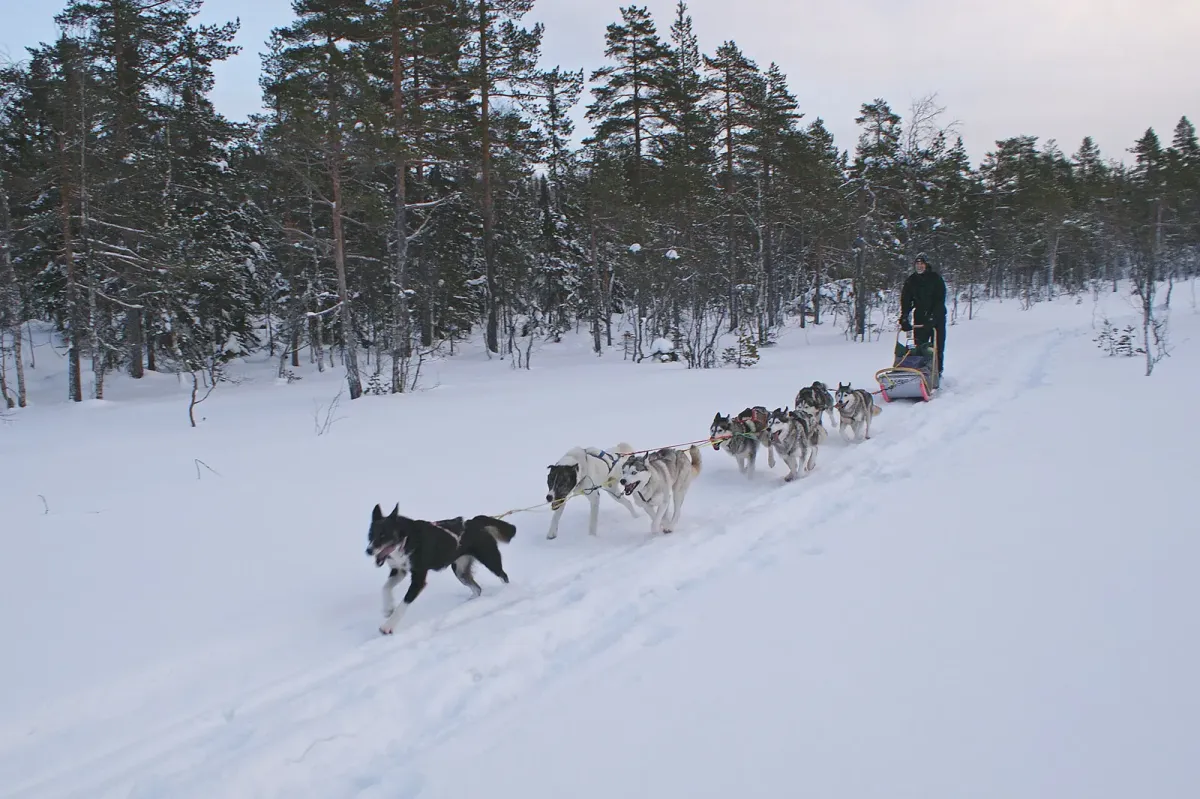
A sled team on a forest trail in Norway. Illustrative. Photo: Randi Hausken from Bærum, Norway, CC BY-SA 2.0, via Wikimedia Commons.
Before the Snow and After It: Carts and Puppies
Two shoulder options keep the dogs in your trip when the sled cannot. Before the snow settles, some kennels run husky tours with wheeled carts, and only when it is cold enough for the dogs. One compared listing states that when snow is short the ride runs on wheeled wagons.
Expect the same dog yard visit, the same harnessing and the same trail network, on wheels.
In summer, from the midnight sun period of about 18 May to 26 July onward, the catalog option is the summer puppy training visit, where you help handlers train the youngest dogs and get lunch. It is the cheapest listing compared and takes all ages, but it includes no sled ride and no snow. Both shoulder options make sense for dog lovers with fixed dates.
Neither should be sold to you as sledding, so read the listing carefully before booking. If sledding on snow is the goal, these are the months to avoid rather than work around. To weigh every option at once, see the best husky dog sledding in Tromsø.
The Best Month If You Only Have One Morning
Some trips allow a single free morning, so here is a ranked shortlist with the trade each choice makes.
- March, for the best all-round morning: nearly 12 hours of light, cold snow and the fullest choice of departures, though it is the busiest month to book around.
- February, for the same trails with quieter bookings: about 7.4 hours of daylight, which still covers a morning sled easily.
- December, for atmosphere over scenery: twilight-only light from late in the month and long dark evenings for watching the sky.
- Early April, for the longest days: excellent early in the month, but check the snowline forecast before committing late in the month.
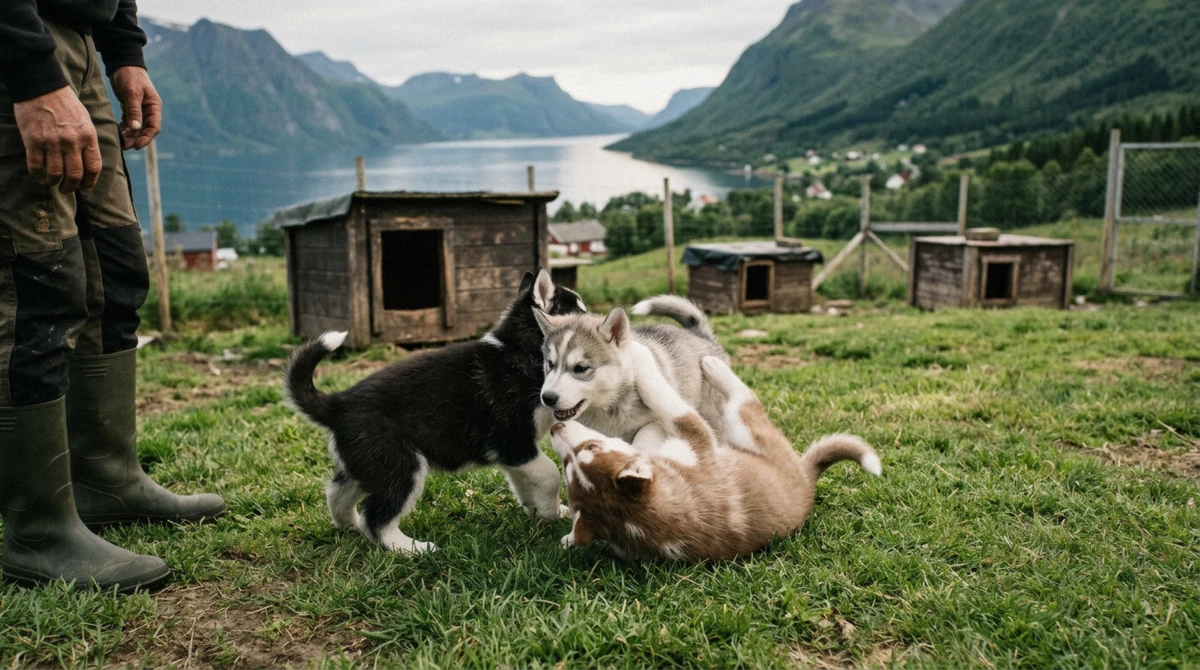
Illustrative image of husky puppies in a summer kennel yard.
Why Coast and Inland Snow Differ
Tromsø sits on the coast, and the sea keeps the city milder than its latitude suggests, with average lows of only about -5°C (23°F) in midwinter. That mildness cuts both ways for sledding. It means the city itself is often at or near freezing, where snow turns wet and heavy, while the inland valleys run several degrees colder and keep the trails dry and fast.
It also means coastal rain events can strip lower trails even in deep winter.
The practical effect is that the kennels are placed where the snow is. The Kvaløya kennels sit a short ride from town, the Breivikeidet camp faces the Lyngen Alps about 50 minutes away, and the Tamok camp is roughly 95 minutes inland where the snow is deeper and colder. On a marginal day, an inland departure is the safer booking, and in dangerous surface conditions operators reschedule, offer a substitute or refund in full.
Best Time of Day
The answer changes with the season, and there is one clear recommendation for each. From November to January, book the latest morning slot you can, because midday is the blue twilight peak and the only time the landscape shows itself. From February to April, morning departures work well, but there is a thaw argument for early starts in April, before the day's warmth softens the coastal snow.
In deep winter the dogs themselves are freshest in the cold, so early season morning runs tend to be lively.
Evening is a different product, not a worse one. After dark in the aurora season, the evening husky visit combines the dog yard and dinner with a camp vantage point, and daytime sled trips return to town in the afternoon, leaving your evening free for a separate northern lights outing if you want one.
Crowds and Prices Through the Year
Prices in this catalog do not swing much by month, because the same tours run through the whole snow season. What changes is availability and what you get per dollar. The comparison below lines up the main options against season and sled time, so you can see where the value sits.
| Option | Season | Price per person | Sled time |
|---|---|---|---|
| Short self-drive ride, Breivikeidet | Snow season, November to April | $233 | Up to 30 minutes |
| Self-drive on Kvaløya | Snow season, November to April | $356 | 70-80 minutes |
| Self-drive with Sámi stew lunch | Snow season, November to April | $360 | About 45 minutes |
| Guided ride with lunch | Snow season, November to April | $360 | About 45 minutes as a passenger |
| Private kennel day, Målselv | Snow season | $435.36 | Adapted to conditions |
| Northern lights husky visit | Aurora season evenings | $194.82 | None |
| Summer puppy training | May to September | $178.50 | None |
The value math is simple. The Kvaløya self-drive works out to roughly $4.45 to $5.09 per minute on the sled, against about $7.77 per minute for the short Breivikeidet ride. The cheapest snow-season entry is $233, and the no-sled options run from $178.50 in summer.
Demand peaks in February and March, so the real cost of waiting is sold-out sled slots rather than higher prices. Full price detail sits in our guide to how much dog sledding in Tromsø costs, and if you are weighing the whole idea, our honest take on whether dog sledding in Tromsø is worth it covers the rest.
So, When Should You Go?
Book February or March if your dates are open. You get the deepest, coldest snowpack, seven to nearly twelve hours of daylight and every tour type running at full strength. If you also want the northern lights, shift earlier into November through January and accept twilight sledding.
If your dates are fixed in late April, pick an inland kennel to dodge the coastal thaw. October is a wheeled-cart month, and summer is for puppy training, so neither is the trip to book if riding a sled on snow is the goal. Whatever month you land on, every listing compared offers free cancellation up to 24 hours before the start, which makes booking early in the season cheaper than booking late.
For gear, see our guide to what to wear dog sledding in Tromsø.
Questions and Answers
What is the best month for dog sledding in Tromsø?
February and March. The snow is deep and cold, the days grow from about 7.4 to 11.8 hours of light, and the average high sits around -1°C (30°F) to 1°C (33°F). Every tour type in the catalog runs at full strength in these months.
Can you go dog sledding in Tromsø in October?
Usually not on snow. October is the wettest month by rain days and averages a high of 5.2°C (41°F), so snow cover is normally too thin. Some kennels run wheeled carts or wagons when it is cold enough for the dogs, which is real dog work but not a sled on snow.
Can you go dog sledding in Tromsø in November?
Yes, on most years. Visit Tromsø puts the usual snow season start in November, and tours run from about 26 November onward under polar night, in a few hours of blue midday twilight. Early in the month some listings switch to wheeled wagons if snow is short, and every compared listing offers free cancellation up to 24 hours before the start.
Is there snow in Tromsø in April?
Often, especially early in the month, but the coast warms fast with an average high of 4.1°C (39°F). Late April rides can be shortened or moved to wheeled wagons. Inland valleys such as Tamok usually hold deeper, colder snow, which is why the Tamok day trip is the safer late-season booking.
How cold is it dog sledding in Tromsø?
Typical winter averages run from highs around -1°C (30°F) in January and February to lows near -5°C (23°F) in midwinter, and inland valleys are colder than the city. Every winter tour compared lends a thermal suit and boots, and most also lend mittens and hats, so you layer up under the suit rather than buy Arctic gear.
Can you go dog sledding in Tromsø in summer?
No, there is no snow between roughly May and September. The summer option in the catalog is a puppy training session at a husky farm, which costs less and suits all ages but includes no sled ride. Wheeled carts at some kennels bridge the shoulder months when the cold allows.